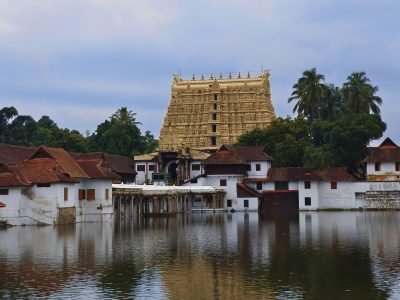
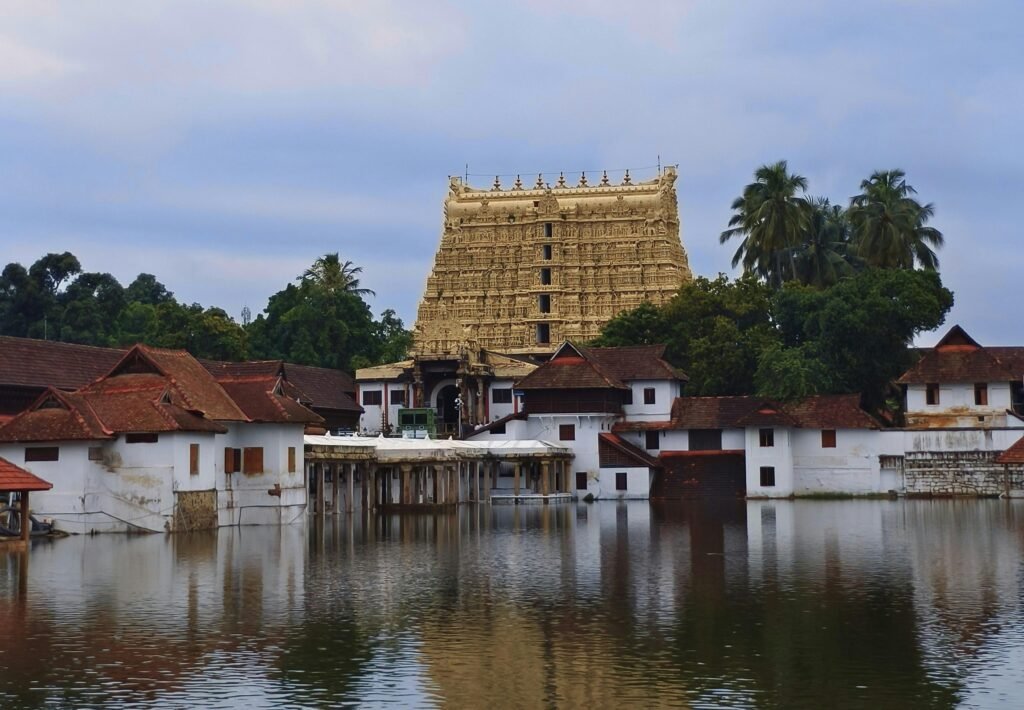
When news broke a few years ago that the Sree Padmanabhaswamy Temple in Thiruvananthapuram was likely the wealthiest place of worship in human history, the world’s eyes turned towards its literal “vaults of gold”.
But for those of us who grew up in the shadow of its seven-tier gopuram, the true treasure has always been the stories etched into its granite and the mysteries woven into its rituals. For locals, the treasure trove often distracts from the incredible engineering and cultural secrets that make this site a global marvel.
If you are planning to visit — or if you simply want to understand the soul of Kerala’s capital — here are 10 things you probably didn’t know about this ancient sanctuary.
1. The Idol is a Fossil Record
Most temple deities are carved from wood or cast in metal. The 18-foot-long idol of Lord Padmanabha, however, is fashioned from 12,008 Salagramas. These are sacred ammonite fossils found only in the Gandaki river in Nepal. They were transported to Thiruvananthapuram on elephant-back and encased in an Ayurvedic paste called Katusarkara Yogam, making the deity a unique geological and medicinal masterpiece.
2. A Twice-Yearly Solar Event
The temple is a testament to ancient astronomical precision. During the Equinoxes (March and September), the setting sun aligns perfectly with the windows of the massive entry tower. If you stand in the right spot, you can watch the sun pass exactly through each of the five openings at five-minute intervals — a stunning “celestial countdown”.
3. The Musical Pillars of Granite
In the Kulasekhara Mandapam, the stone speaks. There are pillars here that, when tapped, produce distinct musical notes. Carving granite — one of the hardest stones on earth — to achieve specific acoustic frequencies is a feat of 18th-century engineering that remains baffling even today.
4. The Single-Stone Platform
Directly in front of the sanctum is the Ottakkal Mandapam. This massive platform is carved from a single, three-foot-thick slab of granite. Because of its sanctity, only the titular Maharaja of Travancore is traditionally permitted to prostrate fully on this stone, signifying his role as the “servant” of the deity.
5. The ‘Three-Door’ Perspective
You cannot see the entire deity at once. The temple is designed with three doors to view the reclining Lord. You see the face through the first door, the navel with the emerging lotus through the middle, and the feet through the third. It is a deliberate architectural choice to remind the devotee of the vastness of the divine.
6. The Temple that Stops an Airport
Trivandrum International Airport is one of the few in the world that halts operations for a religious ritual. Twice a year, the Arattu (ceremonial bath) procession leads the deity across the runway to Shangumugham Beach. The flight schedules are adjusted to respect a tradition that predates the invention of the aeroplane.
7. The Legend of the Sea Gates
Local lore suggests that the deepest vaults of the temple (specifically the mysterious Vault B) are connected to the Arabian Sea. Legend has it that the doors are “locked” by a Naga Bandham (serpent spell) and that forcing them open would cause the sea to rush in and flood the city.
8. The Clock of the Horse (Methan Mani)
Just outside the temple stands the Methan Mani, a historic clock installed in the 1840s. Every hour, two goats ram a man’s face between his cheeks. It was built to commemorate a victory over invaders and remains a mechanical marvel that tourists and locals still stop to watch.
9. The Architecture of Silence
The 1,000-pillar hall (Ayiramkaal Mandapam) is an “architectural forest” of stone. Even on the hottest Kerala afternoon, the interior remains remarkably cool. The sheer volume of stone acts as a natural heat sink, while the layout creates a specific acoustic “silence” that isolates the devotee from the city noise outside.
10. The Living Heritage
The temple isn’t a museum; it is the heart of a living tradition. The Travancore royal family still maintains a deep, daily connection with the temple’s administration. Every ritual, from the daily flowers to the grand Lakshadeepam (festival of one lakh lamps), is performed exactly as it was centuries ago.
Experience the Story
The Sree Padmanabhaswamy Temple is more than a destination; it is a gateway to the history of Travancore. If you want to walk these corridors and hear the stories of the kings who protected this gold, join us on The Ivory Throne Tour.
Ready to explore God’s Own Country?
Drop us a WhatsApp message — we usually respond within 15 minutes.